· RecruitRadar · Recruiting Tips · 4 min read
Getting Started with College Sports Recruiting: How to Build Your Target School List
A practical framework for building your target school list — level, location, academics, and connections — plus the factors most families overlook.
When you’re starting the college sports recruiting process, one of the first questions every family runs into is: what schools should we be considering? There are 1,200+ colleges across NCAA D1, D2, D3, and NAIA. The families who navigate the college recruiting process well aren’t the ones with the longest list, they’re the ones with the most honest one, built using specific criteria to maximize the chances of success.
Here’s the framework we’d recommend for building yours.
1. Start with an honest read on level - NCAA D1, D2, D3, NAIA
Before you can build a list, you need a realistic sense of where your athlete fits — NCAA D1, D2, D3, NAIA, and the tiers within those (high-major, mid-major, low-major, etc.).
Don’t guess at this alone. Get input from people who watch a lot of players and have no reason to inflate your kid’s potential:
- High school coaches
- AAU/club coaches
- Trainer or skills coach, if you have one
It also helps to look sideways, not just up. Compare your athlete’s abilities to others they’ve played with or against who are already being recruited at a given level — that’s often a more honest benchmark than rankings or exposure camp labels.
Once you land on a level, that’s where the bulk of your list should live. But don’t limit to just that level, add some stretch and backup schools:
- 5–10 Stretch schools — a level above, worth pursuing if there’s genuine interest
- 30-40+ Primary target schools — where you’re realistically competitive
- 5–10 Backup schools — a level below, where your athlete would likely play significant minutes early
This isn’t about selling your athlete short or overselling them. It’s about building a list with real range, so you’re not left with nothing if the top of it doesn’t pan out.
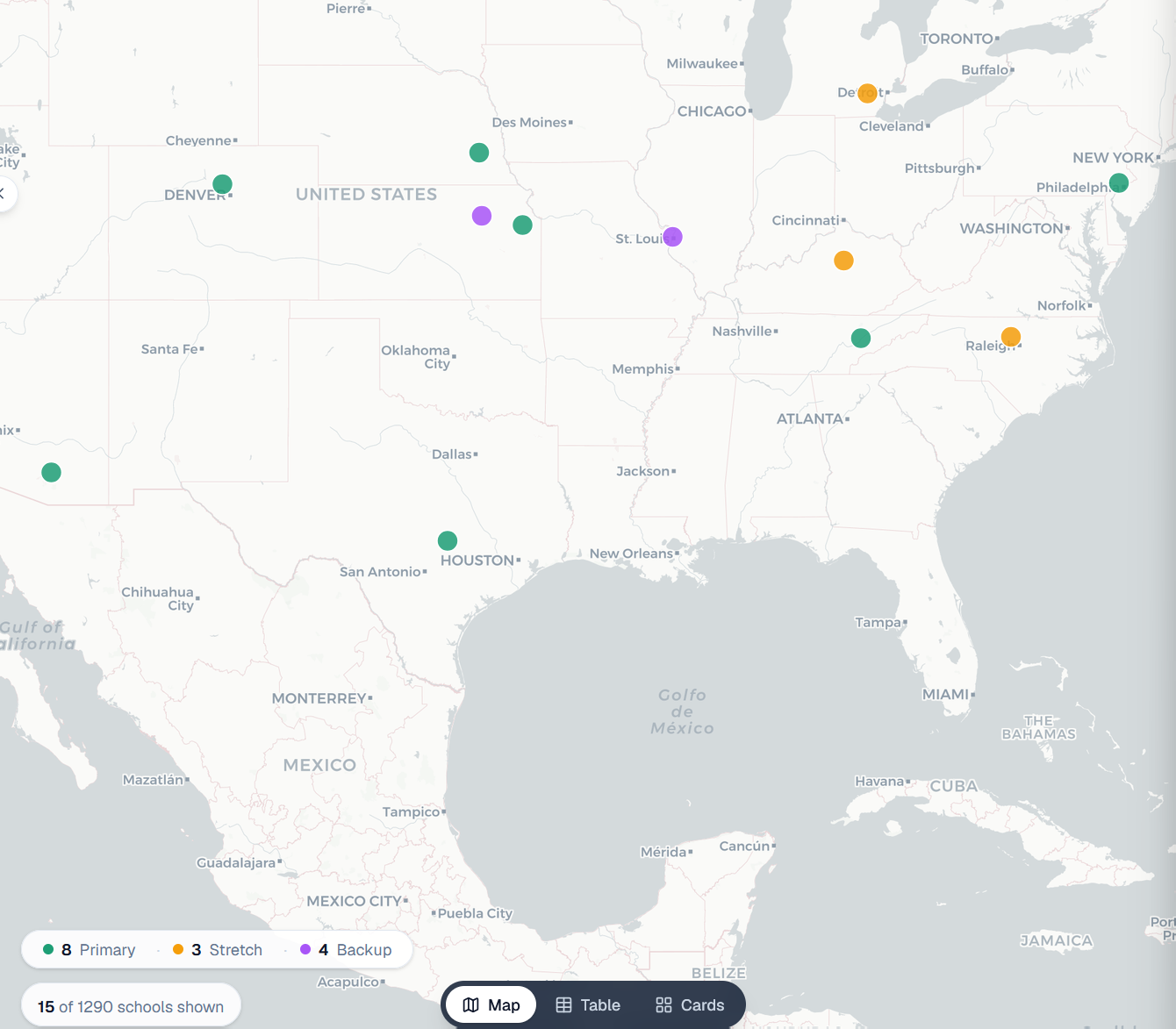
A tiered list in practice — schools color-coded by target type, so the balance of your list is visible at a glance.
2. Location — geography, setting, and school size
This one’s easy to skip past, but it matters more than most families plan for up front. Questions to answer honestly:
- Region: How far from home is realistic? Some families are fine with a cross-country move; others want a drive-able radius.
- Setting: Big city, college town, suburb, or rural campus — these are genuinely different day-to-day experiences, and preference here is legitimate, not superficial.
- School Size: How big or small of a school does your child want to attend? This may not matter to everyone, but could be a consideration for some.
Talk about this as a family, as a parent, you may find your desires do not match your child’s desires.
3. Academic Fit
Compare GPA and test scores against the school’s academic profile. You want to make sure your student-athlete will be able to make the necessary grades in college and remain eligible. For the vast majority of student-athletes, their sports career will end after college. The college degree matters. Pay attention to what your student-athlete wants to major in, and that the colleges you’re targeting offer that degree. Look at school academic rankings for the major you’re interested in.
4. Connections
Do any of your coaches, trainers, or family members have existing relationships with a college program or coaching staff? A warm introduction doesn’t guarantee anything, but it can get a film link actually watched instead of sitting in an inbox. Worth an honest inventory before you start cold-reaching out everywhere.
The list isn’t static
However you build it, don’t treat it as a one-time exercise. Levels get reassessed after a strong summer or a growth spurt. Schools drop off the list after a coaching change, a de-commit at your position, or a program going in a different direction. Plan to revisit the list every few months, not just once at the start. Following this framework will get you started on the right path to ensuring you are targeting the schools where you have the best chance of getting an offer to play.
Next up: In our next post, we’ll walk through how to build and track this list inside RecruitRadar.